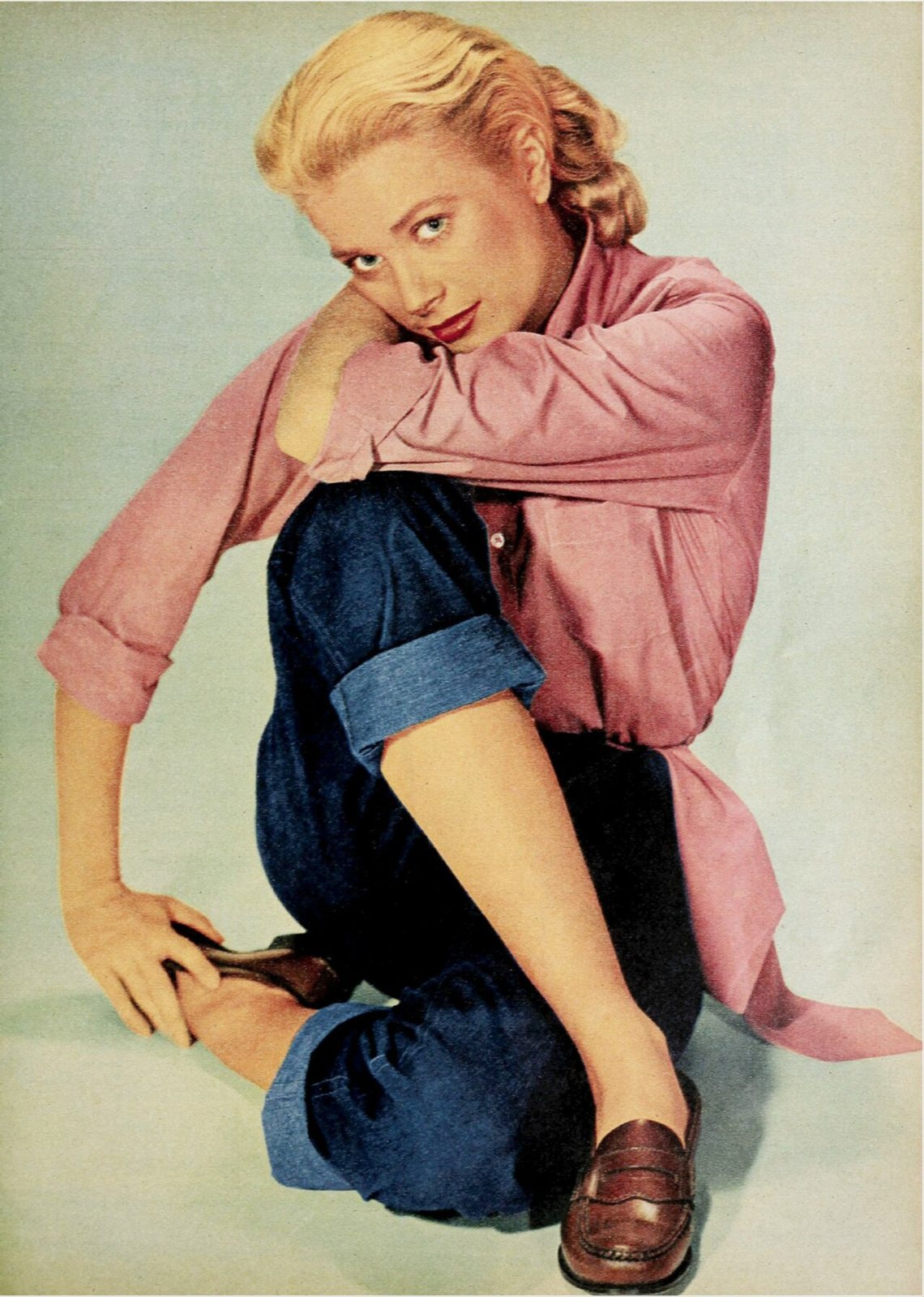
Dell Publications, New York, photo by Paramount, public domain, via Wikimedia Commons
Grace Kelly's whole film career fits inside about five years. She made her first feature in 1951 and her last in 1956, and in between she worked with Gary Cooper, Clark Gable, Cary Grant, James Stewart and Bing Crosby, made three pictures for Alfred Hitchcock and won the Academy Award for Best Actress. Then she stopped, married Prince Rainier III and moved to Monaco.
She was born in Philadelphia on November 12, 1929, which means she would have turned 97 today. She died in 1982, at 52, and the brevity of both careers (actress and princess) is a big part of why people still argue about her.
I've always thought the Hollywood part gets flattened into a montage of gowns and Hitchcock blondes. The actual record is more interesting than that.
A Philadelphia family that expected results
Kelly grew up in a well-off, very competitive family. Her father, John B. Kelly Sr., ran a successful brick business and had won Olympic gold medals in rowing, and her brother John Jr. was a champion rower too. Her uncle, George Kelly, was a Pulitzer Prize-winning playwright, so the theatre wasn't unknown in the family, even if rowing medals were what the Kellys were famous for in Philadelphia.
She went to New York, studied at the American Academy of Dramatic Arts and paid her way partly with modelling work. She made her Broadway debut in 1949 in Strindberg's The Father and then worked steadily in the live television dramas that filled early-1950s schedules. It was a good apprenticeship, the kind where you learned to hit your marks with no second take.
From High Noon to an Oscar in three years
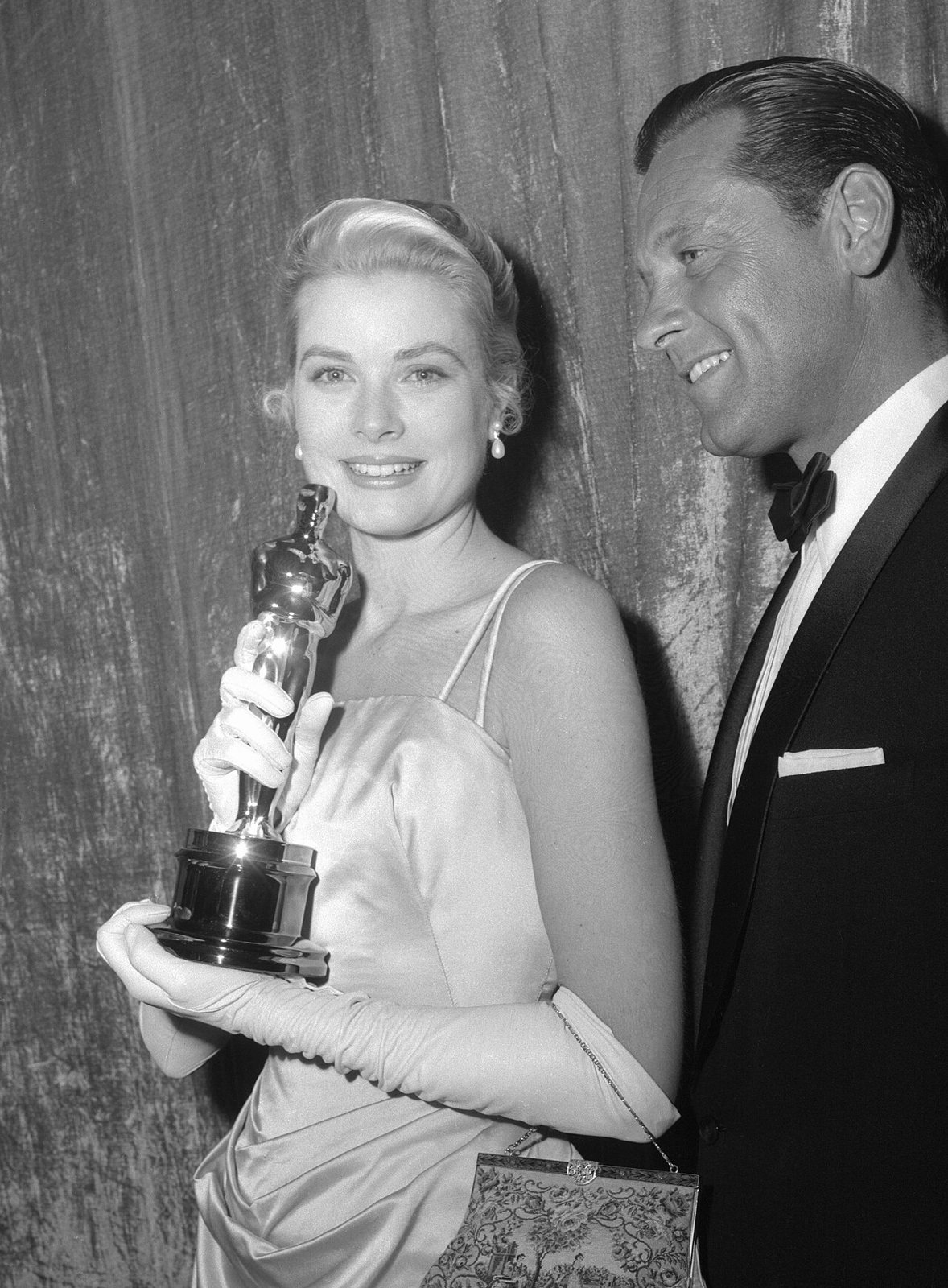
Grace Kelly holding her Academy Award next to William Holden, 1955. Photo: Los Angeles Times, CC BY 4.0, via Wikimedia Commons
Her first film was Fourteen Hours (1951), in a small part. The next year she played Gary Cooper's Quaker bride in High Noon, a big film in which she was, by most accounts, still learning.
Things moved quickly after that. John Ford's Mogambo (1953), opposite Clark Gable and Ava Gardner, earned her an Oscar nomination for Best Supporting Actress and a Golden Globe. Then came 1954, which was close to absurd. Dial M for Murder and Rear Window (both for Hitchcock) and The Country Girl, with William Holden and Bing Crosby, all came out that year, and she also shot The Bridges at Toko-Ri with Holden.
The Country Girl was the one that changed how people saw her. She played the worn-down wife of an alcoholic, fading stage star played by Crosby, with no glamour to hide behind, and it won her the Best Actress Oscar in March 1955. She beat Judy Garland, nominated for A Star Is Born, which is still one of the more debated results in Oscar history. (Garland fans have not let it go, and I can't entirely blame them.)
What Hitchcock saw in her
Hitchcock cast her three times in quick succession, and To Catch a Thief (1955), shot on the French Riviera with Cary Grant, completed the set. He liked actresses who seemed cool on the surface and let something warmer show through, and Kelly became the template people still mean when they say "Hitchcock blonde".
Rear Window is the best place to see why. She plays Lisa Fremont, who arrives in James Stewart's apartment looking like a fashion plate and turns out to be the braver of the two. The film depends on the audience believing she could do both, and they do.
Hitchcock wanted her back. In the early 1960s he offered her the lead in Marnie, and she was reported to be interested, but the idea of the Princess of Monaco returning to the screen went down badly in Monaco and she withdrew. Tippi Hedren took the part.
Cannes, a photo shoot and a royal wedding
Kelly met Prince Rainier III in May 1955, during the Cannes Film Festival, when a magazine arranged for her to be photographed at the palace in Monaco. They corresponded afterwards, the engagement was announced in January 1956, and she finished her last two films, The Swan and High Society, that same year. In High Society she sang "True Love" with Bing Crosby, and the record became a hit.
The wedding took place in Monaco in April 1956, a civil ceremony followed by a religious one at the cathedral. Her dress was designed by Helen Rose, the MGM costume designer, and the event was filmed and broadcast to a very large international audience. MGM, which had her under contract, got the newsreel rights, which tells you something about how Hollywood viewed the whole thing.
Princess Grace, and the bag that kept her name
As Princess Grace she gave up acting and took on the public work expected of the role, with a particular interest in the arts and children's causes. She and Rainier had three children: Caroline, Albert (now Prince Albert II) and Stéphanie.
Her style outlived the films for a lot of people. Hermès renamed one of its handbags the Kelly after she was photographed using one, and fashion writers still pull out her 1950s look every few seasons, the pink shirt and rolled jeans on our cover included.
She died on September 14, 1982, the day after her car left a winding road near Monaco. Doctors said she had suffered a stroke at the wheel. Stéphanie, who was in the car with her, survived.
Where to start watching
If you have never seen a Grace Kelly film, Rear Window is the easy recommendation, and it holds up remarkably well. To Catch a Thief is lighter and gorgeous to look at, while The Country Girl is the one to watch if you want to see the performance that won her the Oscar. High Society is fun, mostly for the songs.
With only eleven films to choose from, you can watch the essential ones over a weekend, and by the end it's easy to see why Hollywood was so sorry to lose her.
Enjoyed this story?Get a new one every day on social.