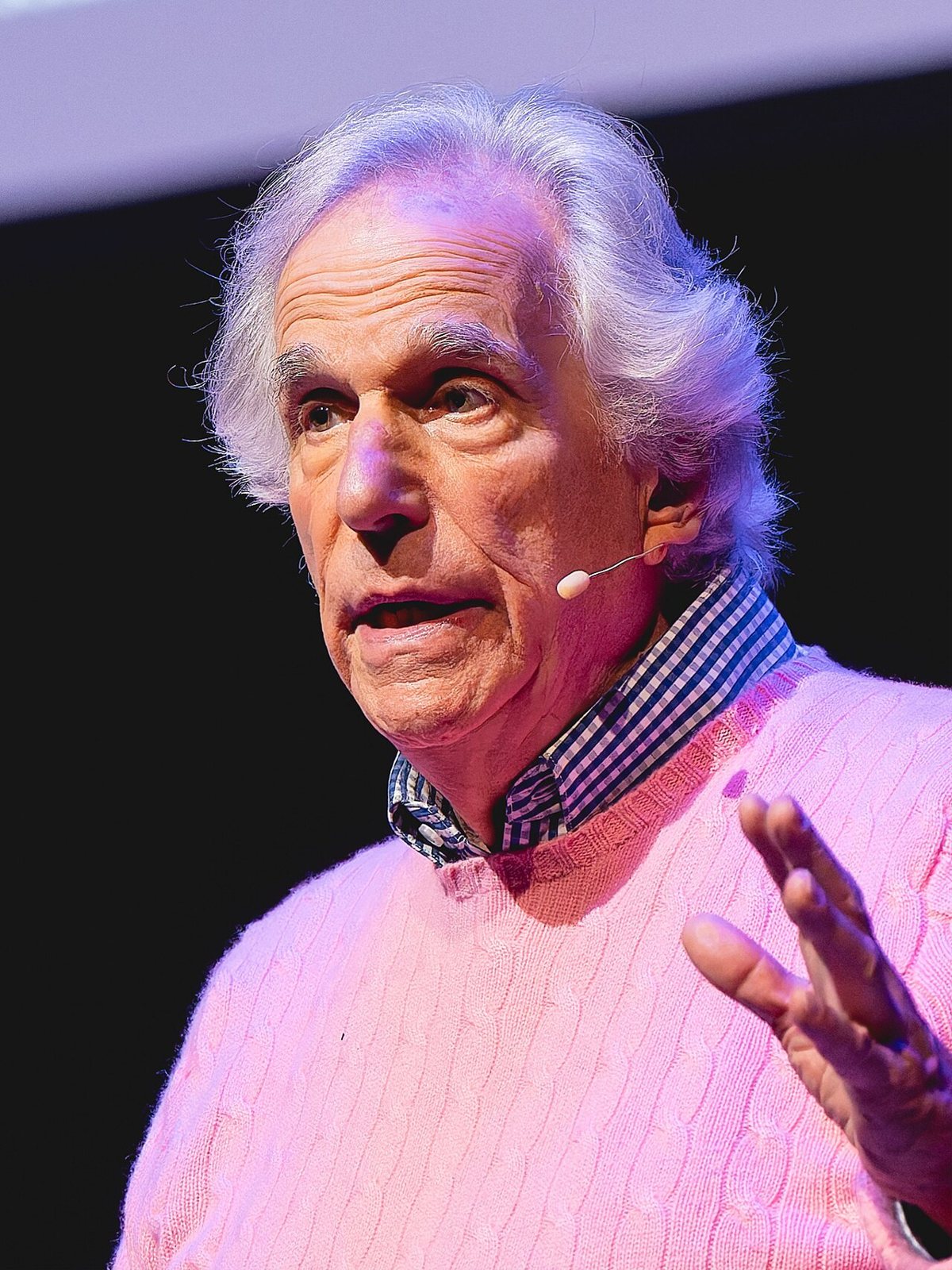
Henry Winkler was born in Manhattan on October 30, 1945, which makes him 81 today. His parents, Harry and Ilse Winkler, had left Nazi Germany in 1939, and they raised him on the Upper West Side with the expectation that he would do well in school.
He didn't, at least not on paper. He struggled with reading and spelling all through childhood and was told often enough that he was lazy. It took until his early 30s for anyone to put a name on it: dyslexia.
By then he was already the most famous leather jacket in America. What I find more interesting is everything that came after the jacket, because Winkler's career is one of the better arguments I know for sticking around.
A Yale-trained actor in a greaser role
Winkler got his undergraduate degree at Emerson College in Boston and then an MFA from the Yale School of Drama in 1970. He did repertory theater and commercials, moved to Los Angeles, and in 1974 was cast in a new ABC sitcom about teenagers in 1950s Milwaukee.
Happy Days was built around Ron Howard's Richie Cunningham. Winkler's character, Arthur Fonzarelli, was a mechanic and dropout who was supposed to be a supporting player. The network was nervous about him from the start. In the early episodes he wore a cloth jacket, and the leather one was reportedly allowed only when he was near his motorcycle, because a leather-jacketed hood was thought to look too much like a juvenile delinquent.
Audiences didn't share the worry. Within a couple of seasons the Fonz was the show's biggest draw, with the thumbs up, the "Ayyy," and the jukebox he could start with a punch. The cloth jacket was retired, and the leather one became part of him.
The jump that named a phrase
In the season five premiere in 1977, the Happy Days gang goes to Los Angeles and Fonzie, wearing swim trunks and his leather jacket, water-skis over a shark in an enclosure. Winkler was a decent water skier and has said he did much of the skiing himself (the actual jump was a stunt double, by most accounts).
The episode did fine in the ratings. Years later, a radio personality named Jon Hein and his college friends started using "jumping the shark" for the moment a long-running show loses its way, and Hein turned it into a website in the late 1990s. The phrase escaped and now gets applied to everything from franchises to political campaigns.
Winkler has taken this with good humor for decades. Happy Days ran until 1984, years after the shark, which he has pointed out more than once. And when Arrested Development cast him as the useless lawyer Barry Zuckerkorn, the writers had Barry hop over a dead shark on a pier. It's one of my favorite in-jokes on television.
The jacket in the Smithsonian
Being the Fonz came with a cost. Winkler has talked openly about how hard it was to get other parts once the show ended, because casting directors could only see the character. He moved behind the camera instead. He was an executive producer on MacGyver, which ran for seven seasons on ABC, and he directed the 1993 comedy Cop and a Half.
The original Fonzie jacket, meanwhile, went to the Smithsonian's National Museum of American History in 1980, while the show was still on the air. That's a strange position to be in at 34: your costume is a national artifact and you can't get cast as anything else.
He also kept a friendship with Ron Howard, who directed him in the 1982 comedy Night Shift. The two have spoken warmly about each other for 50 years, which in Hollywood counts as something close to a miracle.
Dyslexia, diagnosed at 31
Winkler found out he was dyslexic in the late 1970s, when his stepson was being tested for learning problems and Winkler recognized himself in the results. He has said he read scripts slowly, improvised his way through cold reads, and was terrified of being found out.
He turned that into a second career. With the writer Lin Oliver he co-wrote the Hank Zipzer series, starting in 2003, about a boy with dyslexia who is smart, funny and bad at school. Between that series and a follow-up, Here's Hank, the books run to more than two dozen titles, and Hank Zipzer was also made into a British children's TV series. Winkler has spent years visiting schools to talk to kids about learning differences, and I suspect that work matters more to him than any role.
A late-career run nobody predicted
The second act started with comedy cameos. He played the coach in The Waterboy, then Barry Zuckerkorn on Arrested Development, then a recurring part on Parks and Recreation. Younger viewers who had never seen Happy Days started to know him as the funny older guy in other people's shows.
Then came Barry. In HBO's dark comedy, created by Bill Hader and Alec Berg, Winkler played Gene Cousineau, a vain and needy acting teacher in Los Angeles. It was a sharp, sometimes sad performance, and in 2018 it won him the Primetime Emmy for supporting actor in a comedy series. He had been nominated three times for Happy Days in the 1970s and never won. At 72 he finally did, and his speech was a joy to watch.
In 2022 he published a memoir, Being Henry: The Fonz... and Beyond, which became a bestseller. It's candid about the dyslexia and the lean years, and it's worth reading if you only know him from reruns.
Where to watch him now
If you want a short Henry Winkler festival this weekend, start with a couple of early Happy Days episodes to see the cloth-jacket era, then skip ahead to Barry. All four seasons stream on HBO Max in most markets, though availability varies by country. If you have time for only one episode, pick any from season one where Gene is teaching class; you'll see why the Emmy voters finally came around.
Enjoyed this story?Get a new one every day on social.