Home Alone opened in American cinemas on November 16, 1990, and nobody involved expected what happened next. It was a mid-budget family comedy with a ten-year-old lead, a story you could explain in one sentence, and a release date a full five weeks before Christmas. It went to number one and stayed there for weeks, deep into the new year.
Thirty-six years on, it is one of the few holiday films that plays as well to the parents in the room as it does to the kids. I've seen it more times than I would like to admit, and the thing I keep noticing is how carefully it is built. The slapstick finale gets the attention, but the first hour is a small, funny film about a boy who is a bit too pleased to be rid of his family.
A John Hughes idea and a studio that blinked
The script came from John Hughes, who by then had The Breakfast Club, Ferris Bueller's Day Off and Planes, Trains and Automobiles behind him. As Hughes told the story, the idea arrived while he was packing for a family trip and making a list of everything he could not forget. He wondered what would happen if he forgot one of the children.
Hughes produced, and Chris Columbus directed. The project started at Warner Bros., but when the budget began to creep up the studio balked, and 20th Century Fox picked it up. It is one of those decisions that looks expensive in hindsight (for Warner, anyway).
Macaulay Culkin was already known to Hughes from Uncle Buck in 1989, where he had a scene-stealing turn interrogating a visitor through a letterbox. Casting him as Kevin McCallister was close to the obvious choice.
Most of the house was a gym
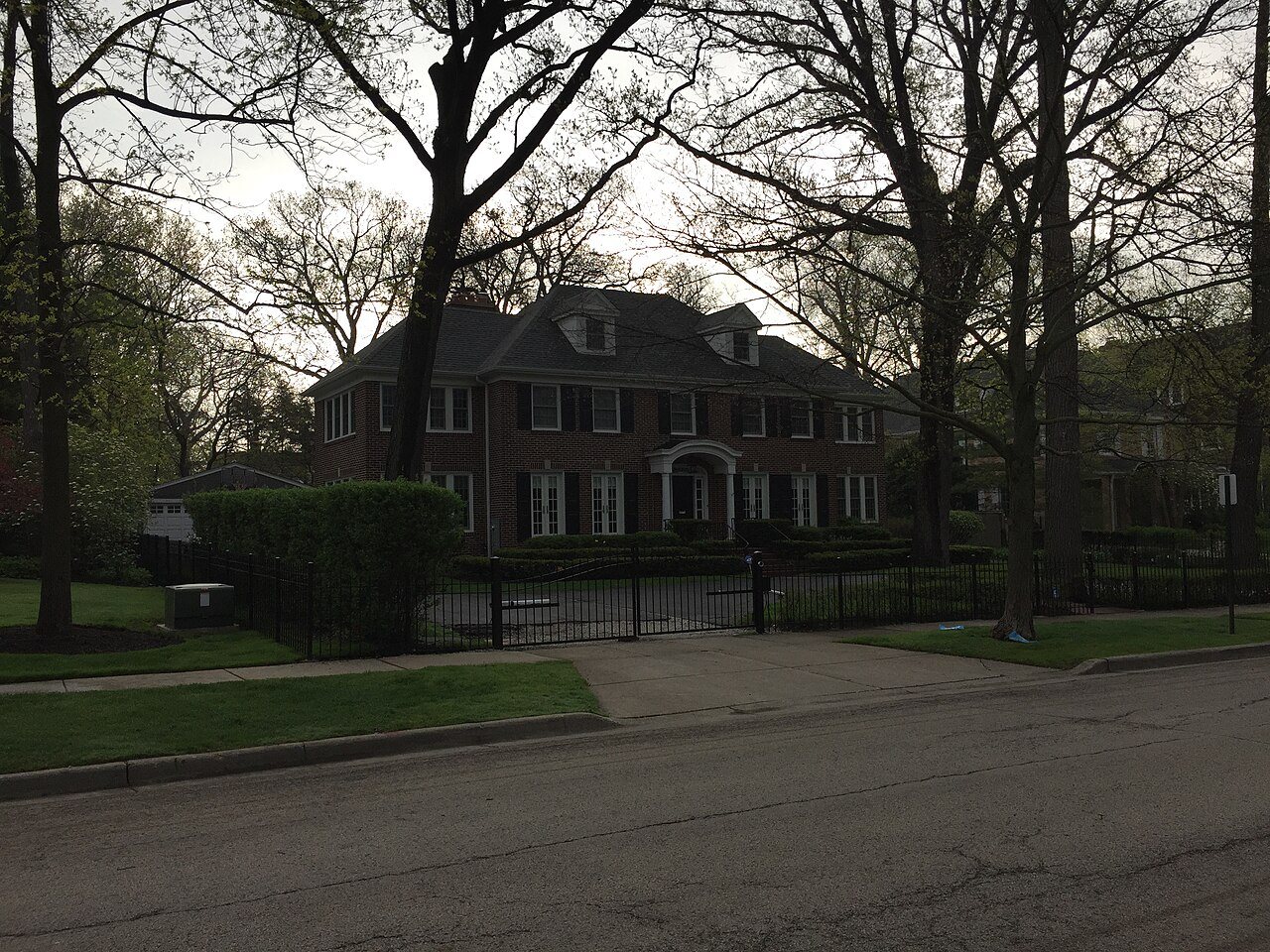
The McCallister home is a real place: a red-brick Georgian house on Lincoln Avenue in Winnetka, one of the leafy suburbs north of Chicago. The production used it for exteriors and for a number of interior shots, but a lot of what you see inside was built on sets in the gymnasium of a closed high school nearby, New Trier West in Northfield.
That split is why the house can feel bigger on screen than it looks from the street. The staircase Kevin sleds down and the basement with the menacing furnace are the parts most people remember, and the sets gave the crew room to stage the stunts without wrecking someone's actual home.
Angels with Filthy Souls was never a real film
One of the best jokes in the movie is a movie inside it. Kevin keeps scaring off visitors by playing a black-and-white gangster picture called Angels with Filthy Souls, complete with tommy guns and the line about keeping the change. It looks like a forgotten 1930s or 1940s crime film, and plenty of people assumed it was one.
It was shot for Home Alone. The title is a riff on Angels with Dirty Faces, the 1938 James Cagney classic, and the filmmakers made just enough of it to cut into the story. The sequel, Home Alone 2: Lost in New York, brought back the gimmick with a follow-up, Angels with Even Filthier Souls.
Pesci, Stern and a polka king in a van
Joe Pesci and Daniel Stern play Harry and Marv, the burglars who call themselves the Wet Bandits. Pesci had just finished Goodfellas, released the same autumn, and the contrast between the two roles is one of the funnier double bills of 1990.
Catherine O'Hara gives the film its heart as Kate, Kevin's mother, who spends most of the running time trying to get home from Paris. Her journey ends in the back of a van with Gus Polinski, a polka band leader played by John Candy. Candy's part is small, and he reportedly shot it in one long day, but his scenes are among the warmest in the film.
Then there is the music. John Williams wrote the score, which earned an Oscar nomination, and the song "Somewhere in My Memory" was nominated too. That theme does a lot of quiet work. Take it away and the ending would feel much thinner.
How big it got
Home Alone stayed at the top of the American box office for about three months and went on to earn roughly $476 million worldwide. For around two decades it was usually cited as the highest-grossing live-action comedy of all time. Not bad for a film the first studio thought was getting too expensive.
The sequel followed in 1992 with most of the original cast, and the franchise kept going with more sequels and a 2021 Disney+ reboot, Home Sweet Home Alone. None of those caught on the same way. My guess is that the original works because Kevin is not a superhero. He's a scared kid who finds out he is braver than his family thinks, and the traps are his way of proving it.
Watching it this year
Home Alone is part of the Disney catalogue now, since Disney bought Fox's film business, so it is usually easy to find on Disney+ in December. If you are rewatching, pay attention to the first act rather than skipping to the paint cans. The scenes of Kevin alone in the house, shopping for groceries and talking himself out of being afraid, are where the film earns its reputation.
And if you are ever in Winnetka, the house on Lincoln Avenue is still a private home. Fans stop by to take pictures from the pavement every Christmas season, which is fine. Please don't go up to the door.
Enjoyed this story?Get a new one every day on social.