Photo: Aline Livier, CC BY-SA 4.0, via Wikimedia Commons
The first thing you see in Spectre is a crowd. Crowds in skull paint and black suits pour through the streets of Mexico City, giant skeleton puppets sway over their heads, and Daniel Craig, wearing a bone-white mask and a top hat, walks through all of it with a woman on his arm and a job to do.
It is a terrific opening. It is also, as plenty of Mexican viewers pointed out in 2015, a parade that did not exist. Mexico City had altars, candlelit cemeteries, marigolds and sugar skulls for the Day of the Dead, but it had no grand procession of floats and costumed dancers down its main avenues.
A year later, it did. This weekend the holiday is in full swing again (November 1 and 2 are the main days), and the big parade that a Bond film invented is now one of the most photographed events on the city's calendar.
What Spectre put on screen
Spectre was Craig's fourth outing as 007, directed by Sam Mendes and released in the fall of 2015. Mendes opened it with a long, unbroken-looking tracking shot that follows Bond from the street, through a hotel and out across the rooftops above the celebrations, before the whole thing turns into a fistfight in a helicopter spinning over the Zocalo, the city's enormous central square.
The production shut down parts of the historic center to film it, and the crowd scenes used a very large number of extras in costume and makeup. Whatever you think of the rest of the movie (I'm in the camp that thinks it runs out of steam after the first hour), that sequence is the part people remember.
What viewers outside Mexico didn't know was that the filmmakers had built a spectacle from scratch. The skeleton floats and the marching crowds were an imagined version of the holiday, closer to a carnival than to the quiet family vigils most Mexicans actually keep.
The real holiday the film borrowed
The real Day of the Dead is mostly a family affair, and a much older one. Families build ofrendas, home altars loaded with photographs of relatives who have died, along with candles, bread, the dead person's favorite food and drink, and bright orange cempasuchil marigolds whose scent is said to help guide the spirits home. In many towns people spend the night in the cemetery, cleaning and decorating graves.
Traditionally November 1 is set aside for children who have died and November 2 for adults. The customs blend Indigenous traditions with the Catholic feasts of All Saints and All Souls, and UNESCO added the festivity to its list of the world's intangible cultural heritage in 2008.
The elegant skeleton lady you see everywhere this time of year, La Catrina, comes from an etching by the printmaker Jose Guadalupe Posada in the early 1900s. He meant her as a jab at Mexicans who aped European high society. Diego Rivera later put her at the center of a famous mural and gave her the name that stuck.
From movie set to city tradition
After Spectre came out, Mexico City's government decided that if the world now expected a parade, it might as well have one. The first official Day of the Dead parade went down Paseo de la Reforma toward the Zocalo in late October 2016, using floats, giant skeleton figures and dancers.
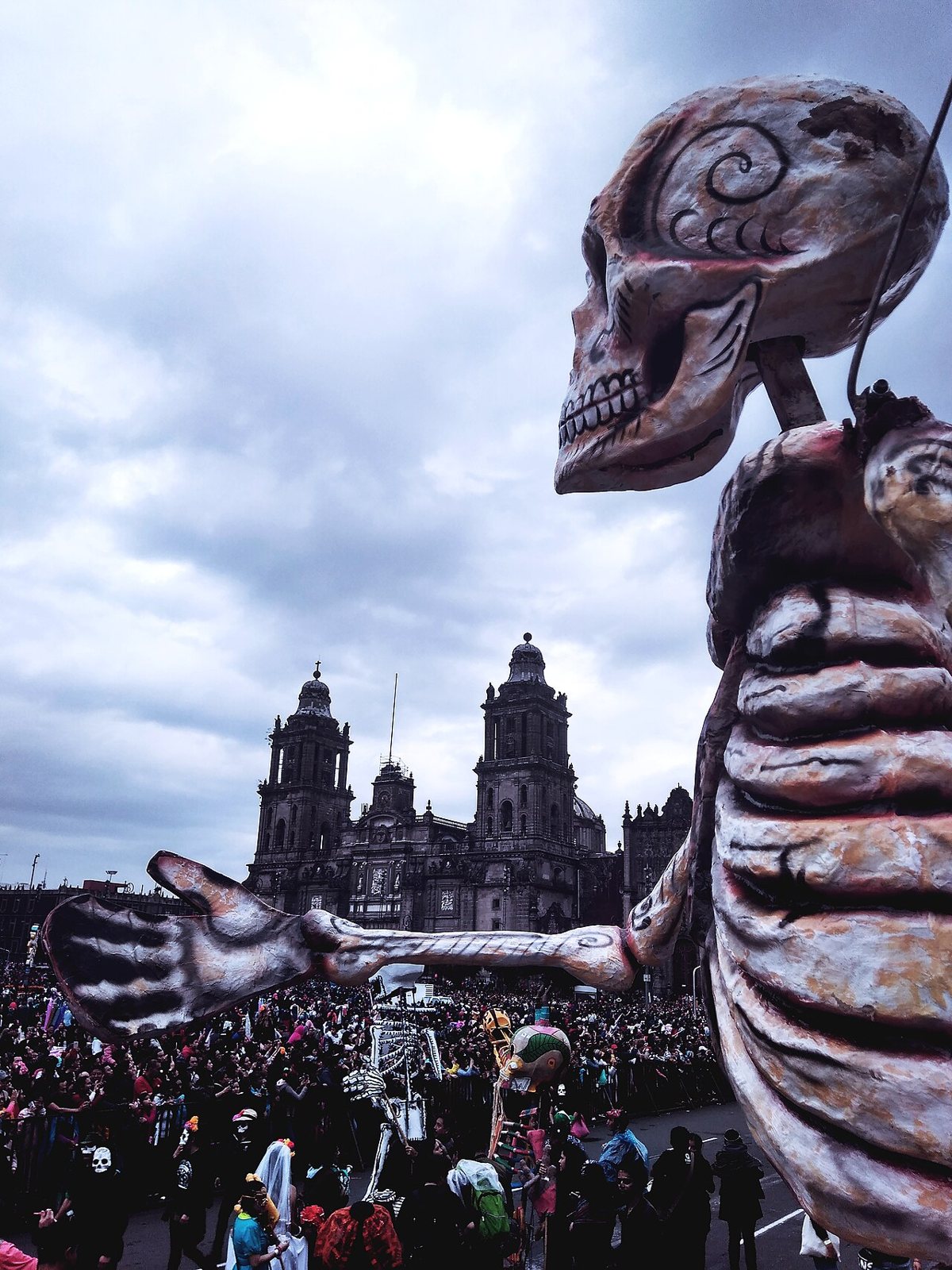
Officials reported crowds in the hundreds of thousands, and the event has returned every year since. It has grown into a full program of floats, marching bands, catrinas on stilts and enormous puppets like the one in the photo at the top of this page, which is reaching over the crowd in front of the Metropolitan Cathedral.
The idea drew some grumbling at the time, the complaint being that a Hollywood fantasy was being sold back to the city as tradition. I understand it, though I'd point out that every big public festival was invented by somebody at some point. This one just happens to have a very well-documented origin story.
Coco and the second wave
Two years after Spectre, Pixar's Coco did even more to put the holiday in front of a global audience. The 2017 film follows a boy named Miguel into the Land of the Dead, and it treated ofrendas, marigold petals and family memory with real care. It won the Academy Award for best animated feature and became a huge hit in Mexico itself, which is no small thing for a Hollywood film about a Mexican holiday.
Between a spy movie that invented a parade and a cartoon that explained the altars, a lot of people outside Mexico learned what the Day of the Dead actually is during the 2010s.
If you're going this year
The parade is free and runs along Reforma toward the historic center. It draws enormous crowds, so arrive early if you want a spot near the barriers, and check the city government's announcements for this year's route and date before you go, since both have shifted over the years.
The Zocalo usually hosts a large public ofrenda during the holiday, and the city's cemeteries and neighborhood altars show you the quieter, older side of the celebration. Rewatching the first ten minutes of Spectre before you go is optional, but I'd recommend it. It's fun to see where it all started.
Enjoyed this story?Get a new one every day on social.