Shawn Miller/Library of Congress, Public domain, via Wikimedia Commons
Joni Mitchell was born Roberta Joan Anderson on November 7, 1943, in Fort Macleod, Alberta, and she turns 83 today. That alone would be worth a toast. What makes it a better story is that a few years ago a lot of fans had quietly assumed they would never hear her sing in public again.
She had a brain aneurysm in 2015 and spent years relearning how to walk and talk. Then in July 2022 she walked onto a stage at the Newport Folk Festival, unannounced, and played. I have watched the footage more times than I would like to admit.
The comeback is the headline. The rest of the career is the reason the comeback mattered.
A prairie kid who had to invent her own guitar
Mitchell grew up mostly in Saskatchewan, and at nine she caught polio during the 1950s epidemic. She has talked about lying in a hospital ward and singing to the other kids. She recovered, but she has also said the illness left her left hand weaker than it should have been, which made standard guitar chords harder to hold.
Her answer was to retune the guitar. Mitchell has used dozens of open and altered tunings over the years, many of them her own, so that a simple shape under the fingers would produce a full, strange chord. It is a big reason her songs sound like nobody else's, and a big reason guitarists who try to learn them from a chord chart end up confused. (I speak from experience here. Do not try "Chelsea Morning" in standard tuning.)
She learned on a ukulele first, moved to guitar, and played coffeehouses in Saskatoon and then in Toronto. In 1965 she married the American folk singer Chuck Mitchell, kept his surname after they split, and moved for a while to Detroit, where she worked the club circuit.
Other singers had her hits first
Before most people knew her name, they knew her songs. Tom Rush recorded "The Circle Game" and Judy Collins had a hit with "Both Sides Now" in the late 1960s, a song Mitchell had written in her early twenties. That kind of songwriting reputation got her to Los Angeles and a record deal.
David Crosby produced her debut, Song to a Seagull, in 1968. Clouds followed in 1969 and won her a Grammy. Ladies of the Canyon in 1970 gave us "Big Yellow Taxi" and her own version of "Woodstock," a song she wrote about a festival she didn't actually attend. She stayed in New York to do a television appearance, and wrote it from what she saw on TV and heard from friends. Crosby, Stills, Nash and Young had the bigger hit with it.
Blue, and everything after it
Then came Blue in 1971. It is a short record, ten songs, mostly just her voice with guitar, piano or Appalachian dulcimer, and it is about as personal as pop albums got at the time. "A Case of You," "River" and "California" are all on it. "River" in particular has turned into a standard Christmas-season cover, which is funny for a song about wanting to skate away from your own life.
Blue has been near the top of nearly every "greatest albums" list for decades. Rolling Stone ranked it third in its 2020 revision of the 500 Greatest Albums.
What I like about her career is that she didn't stay there. Court and Spark in 1974, with jazz players backing her, was her biggest seller. Hejira in 1976 is a road album built around Jaco Pastorius's fretless bass. In 1979 she made Mingus, a collaboration with the jazz bassist Charles Mingus, who died before it came out. Some of her old folk audience did not follow her into jazz, and she does not seem to have lost much sleep over it.
She is also a serious painter, and she has said she thinks of herself as a painter first. A lot of her album covers are her own work, including several self-portraits.
The years away and the road back
By the 2000s Mitchell had mostly stopped recording and performing. She spoke openly about her frustrations with the music business. In 2015 the aneurysm put her in the hospital, and for a while the public news about her health was very thin.
The way back was slow and largely private. The singer Brandi Carlile began hosting what fans called Joni Jams at Mitchell's home, informal sessions where musicians played her songs and, eventually, Mitchell joined in. Newport 2022 grew out of those evenings. The live album from that set, Joni Mitchell at Newport, won the Grammy for Best Folk Album, and at the 2024 Grammys she sang "Both Sides Now" on the broadcast. It was her first time performing at the ceremony, which is almost hard to believe.
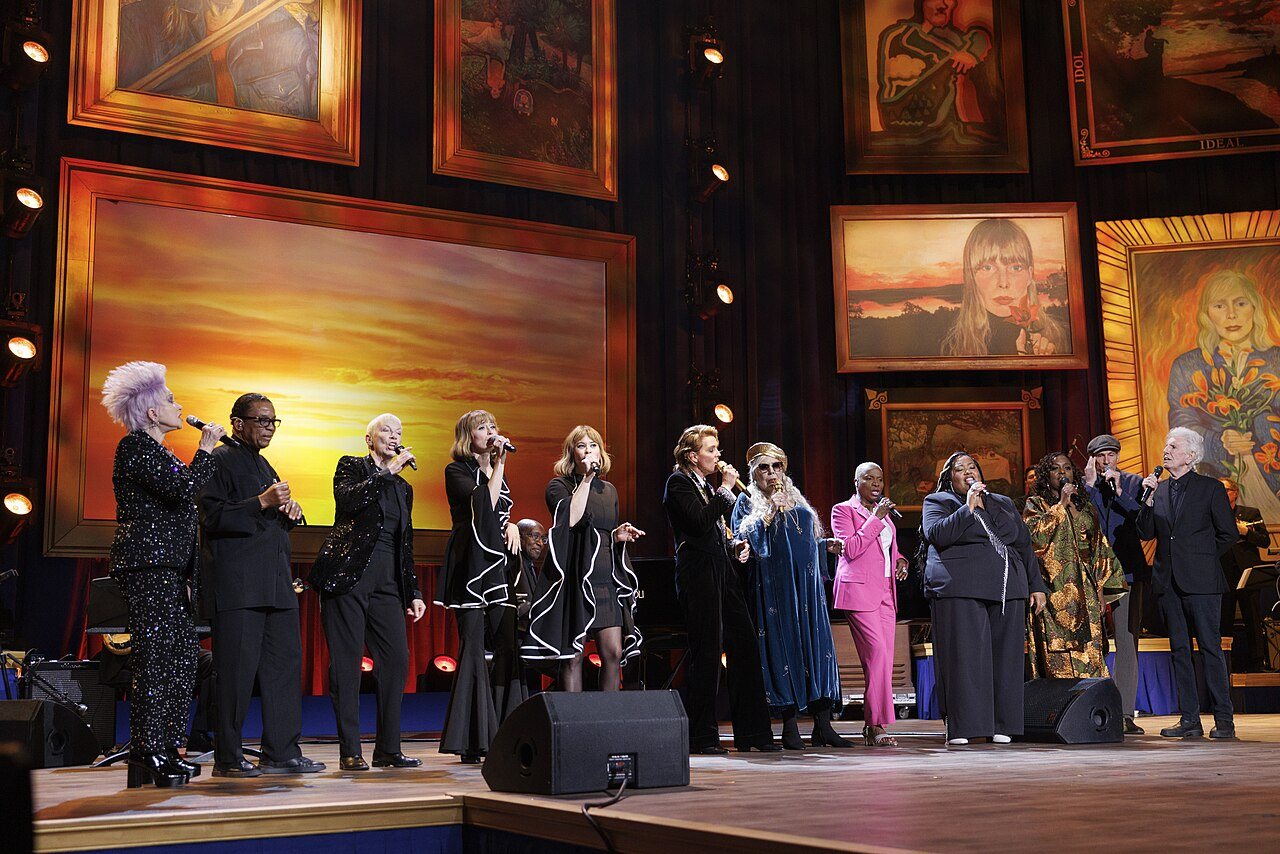
The Library of Congress gave her the Gershwin Prize for Popular Song in 2023, with a concert in Washington where a long line of younger artists sang her songs back to her. She also played two shows at the Hollywood Bowl in October 2024, her first concerts of her own in Los Angeles in a very long time.
Where to start if you only know the hits
If you know "Big Yellow Taxi" from the radio and not much else, start with Blue, all the way through, ideally on a rainy evening. Then jump to Hejira and see if you can believe it's the same person five years later.
For the comeback, the Newport recording is the one to hear. Her voice is lower and rougher than it was in 1971, and that's sort of the point. She was 78 and singing "Both Sides Now," a song she wrote at about 23 about not understanding life yet. It lands differently now.
Happy birthday, Joni.
Enjoyed this story?Get a new one every day on social.