Photo: James Honeyball, CC BY-SA 2.0, via Wikimedia Commons
On October 27, 2014, Taylor Swift released 1989, an album named after the year she was born. She had been edging toward pop for a while (Red, two years earlier, already had "We Are Never Ever Getting Back Together" on it), but 1989 was the first record she presented as pop from start to finish. There isn't a banjo anywhere on it.
It sold 1.287 million copies in the United States in its first week, the biggest opening week for any album since 2002. It also won the Grammy for Album of the Year.
Exactly nine years later, on October 27, 2023, she put the whole thing out again as 1989 (Taylor's Version). So today is a double anniversary, and a decent excuse to look at why this one album keeps coming back.
The big swing to pop
Swift worked on 1989 with Max Martin, the Swedish songwriter and producer behind a large share of the biggest pop hits of the previous fifteen years, and his regular collaborator Shellback. Martin was credited as an executive producer alongside her. Jack Antonoff, who would go on to become one of her most frequent partners, also turned up on several tracks.
The move looked risky at the time, because Swift had built her audience on country radio and nobody could be sure that audience would follow her. She dealt with the doubt by announcing the album and releasing "Shake It Off" in August 2014, a song so relentlessly cheerful that it more or less dared people to complain.
Singles that kept handing off to each other
"Shake It Off" debuted at number one on the Billboard Hot 100. In November, "Blank Space" replaced it at number one, which made Swift the first woman in the chart's history to knock herself out of the top spot.
The singles kept coming for well over a year. "Style," "Bad Blood" (the remix with Kendrick Lamar went to number one), "Wildest Dreams," "Out of the Woods" and "New Romantics" all got their turn. My personal pick is "Style," which has aged better than almost anything else on the record, though I know "Blank Space" people will fight me on that.
The streaming fights
The album also arrived in the middle of the music industry's argument about streaming, and Swift picked a side. In November 2014 she pulled her catalog from Spotify, saying in public that music should not be free. It stayed off the service until June 2017.
Then in June 2015 she published an open letter to Apple, objecting to its plan not to pay artists during the free trial period of the new Apple Music service. Apple reversed the policy within a day. Whatever you thought of her motives, it was a rare case of a single musician changing a tech company's terms overnight, and 1989, unsurprisingly, showed up on Apple Music soon after.
A tour, a Grammy and a cover album
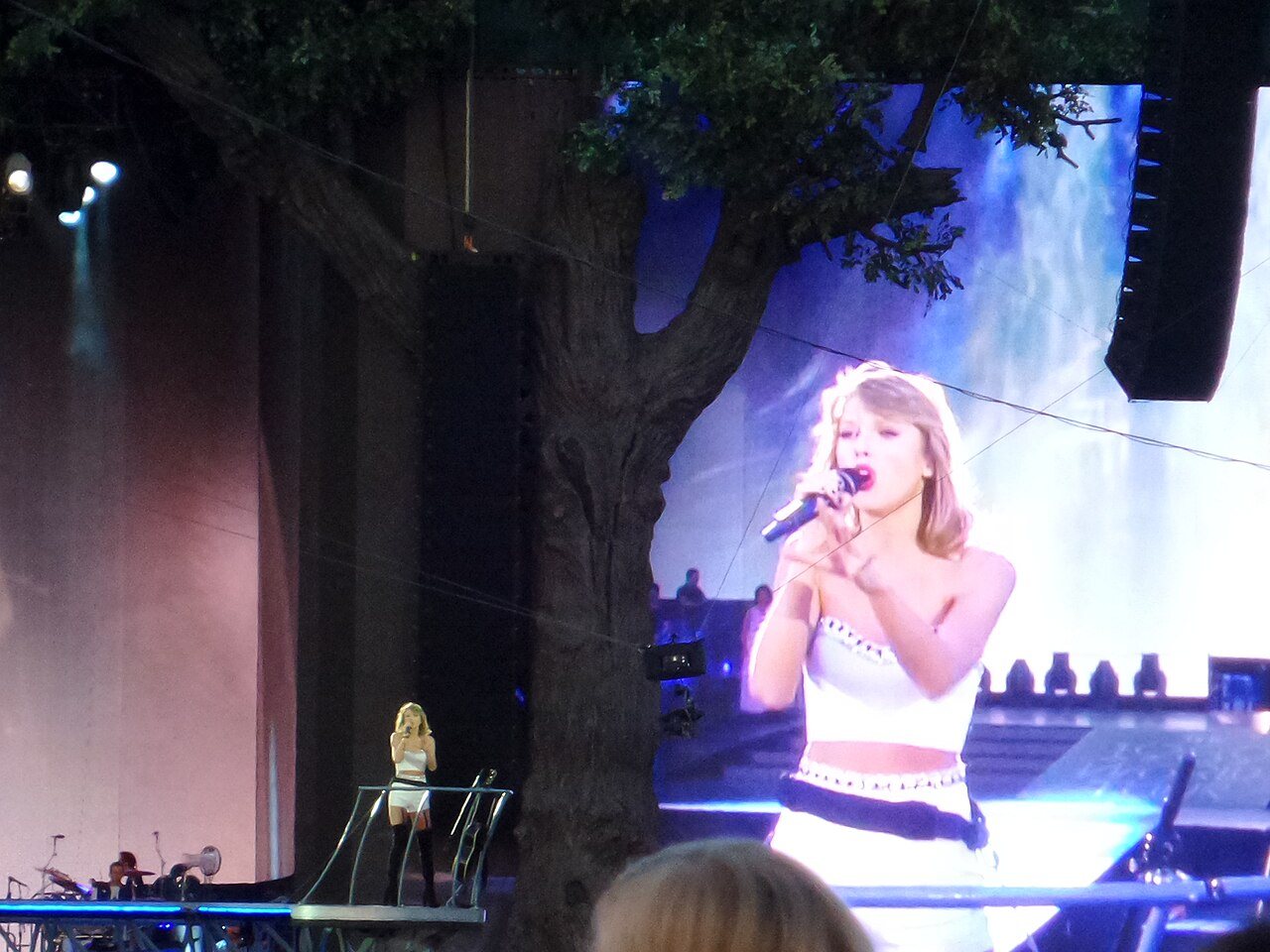
The 1989 World Tour ran through 2015 and was the highest grossing tour of that year. The photo at the top of this story comes from one of its stadium dates, which gives you a sense of the scale: Swift on a small platform, her face several stories high on the screen next to her.
In February 2016 the album won Album of the Year at the Grammys, her second win in the category after Fearless. That made her the first woman to win it twice as a lead artist. It also picked up Best Pop Vocal Album, and the "Bad Blood" video won Best Music Video.
There was one odd little sequel. In 2015 the rock songwriter Ryan Adams recorded a complete cover version of 1989, track by track, in a slower and sadder register. It is worth hearing once, if only to notice how well the melodies hold up when you strip out the gloss.
Why there is a Taylor's Version
The re-release exists because of a fight over ownership. Swift's first six albums, 1989 included, were recorded for Big Machine Records, which owned the master recordings. When Big Machine was sold in 2019 to Ithaca Holdings, the company run by music manager Scooter Braun, Swift objected publicly and announced she would re-record those albums so she could own new versions of them.
1989 (Taylor's Version) was the fourth of those re-recordings. It added five previously unreleased songs "from the vault," including "Is It Over Now?" and "Now That We Don't Talk," and it opened with more than 1.6 million equivalent album units in the United States in its first week, outselling the original's debut.
Where things stand now
The story got a tidy ending in May 2025, when Swift announced that she had bought back the masters of her first six albums. The original 1989 recordings belong to her now, so the re-recordings are no longer a workaround so much as a second edition.
If you are going to mark the anniversary, the obvious move is to play the two versions side by side. The differences are small but real: her voice is a little lower and steadier in the 2023 takes, and some of the production is cleaner. I still reach for the 2014 "Style" first, out of habit more than anything. The vault tracks are the best reason to spend time with the newer one.
Enjoyed this story?Get a new one every day on social.